The forecast was perfect. The shelf was empty.
A demand forecast promised 340 units of Greek yogurt across the southeast cluster by Friday. The model was confident. The dashboard was green. The replenishment order fired on its own.
By Wednesday, three stores hit zero. The distribution center was full.
The forecast was right. The shelf was empty. The customer left.
This is the gap RETAiLABS was built to close: not another forecasting model, but an intelligence layer that helps retailers trust the data behind planning, inventory, replenishment, and margin decisions before those decisions are automated.
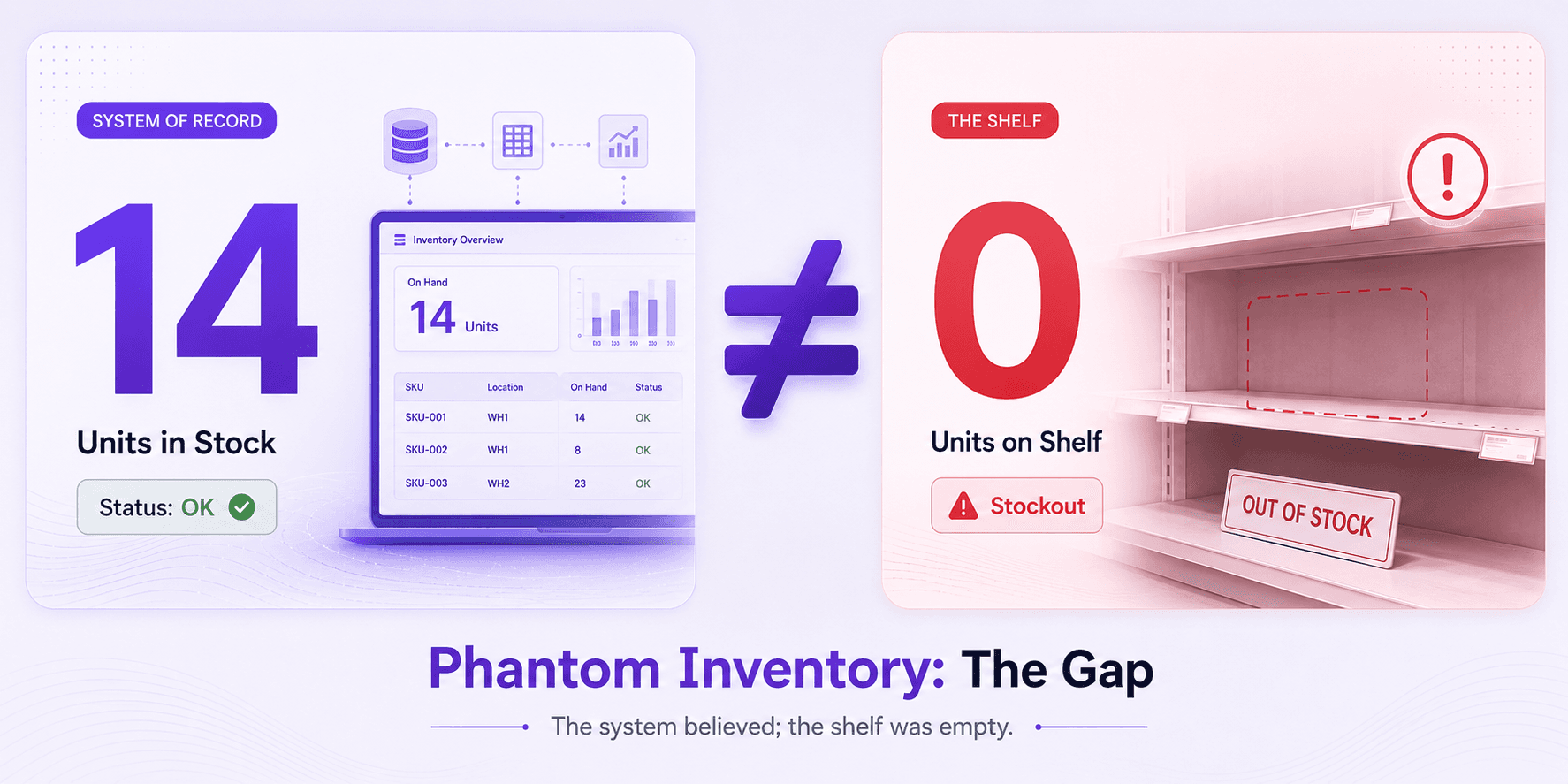
The model is rarely the problem. The data beneath it is.
The problem we never fixed
This is not a legacy problem. It is happening inside modern retail systems every day.
• Inventory distortion still costs retailers roughly $1.7 trillion a year.
• Grocery out-of-stocks sit near 8.3% and have held there for decades.
• Phantom inventory is a major driver of out-of-stocks.
Retailers modernized the models, but many never fully modernized the data foundation those models depend on.
From bad inputs to bad decisions at scale
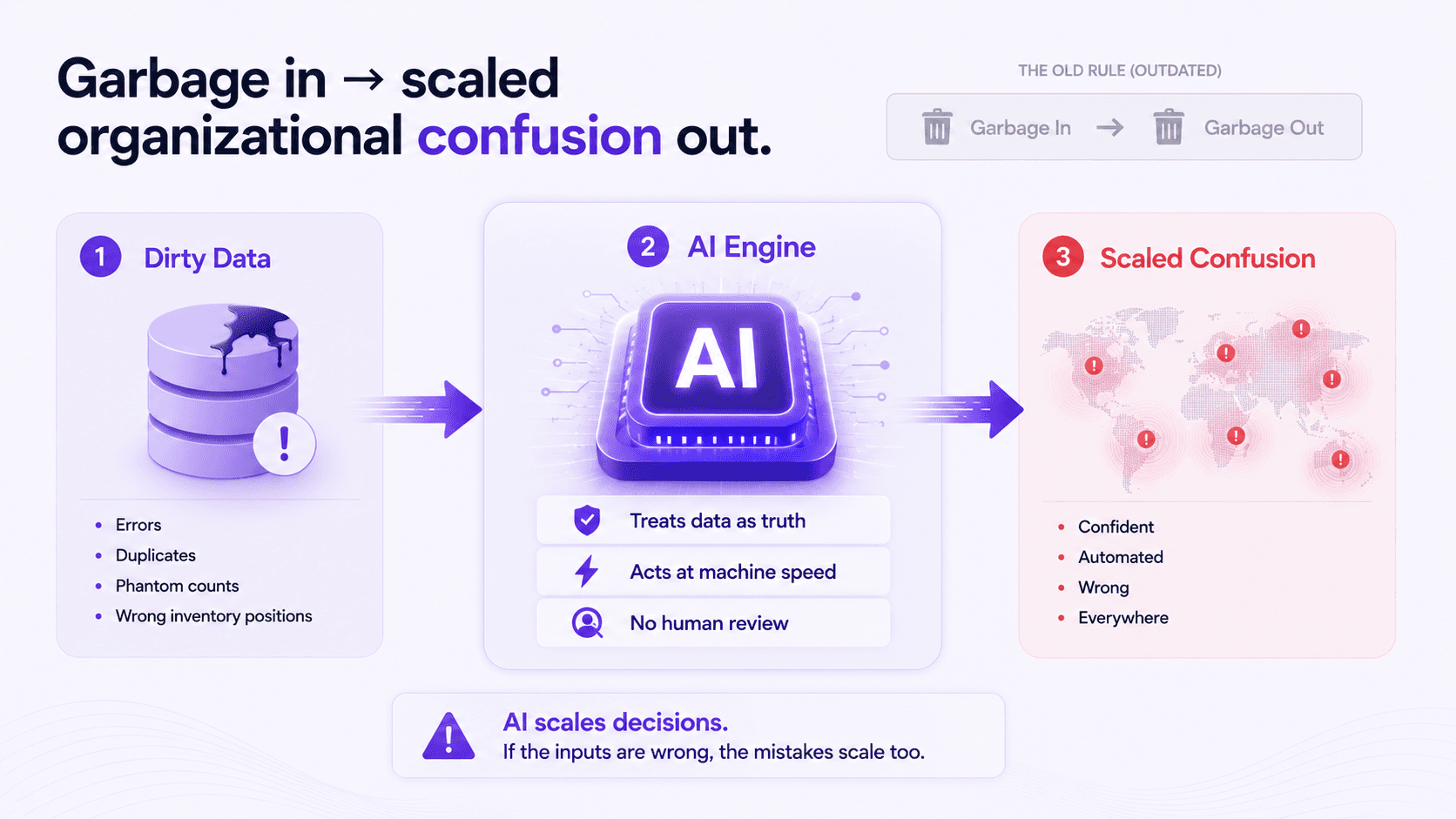
Every operator learned the old rule: garbage in, garbage out. It always assumed a human sat between the report and the decision — someone who squinted at a bad number, distrusted it, and picked up the phone. That person is being designed out. Feed AI the same broken data and it doesn't hesitate: it acts, faster and at scale, with total confidence.
We were warned. Nike’s new demand system over-ordered the wrong shoes and air-freighted the fix at eight times the cost. Target Canada hand-keyed 75,000 products with no validation and closed 133 stores inside two years. Walmart, working from clean transaction data, found that strawberry Pop-Tart sales spike sevenfold before a hurricane — and still pre-stocks them today. Public retail examples have shown the same pattern from different angles: planning systems do not fail in isolation. They fail when product data, location data, inventory records, business rules, and operating processes are not aligned. The lesson is not that technology does not matter. It is that technology only performs as well as the data and operating model around it.
Now we’ve handed it the keys
Here is what changed. The industry’s answer to the data problem is to automate harder. Every major platform now sells autonomous agents, touchless planning, and decisioning over forecasting. Gartner expects 15% of day-to-day work decisions to run autonomously by 2028, up from zero in 2024. The human who used to squint is being designed out — on purpose.
The results are already in. MIT found that 95% of enterprise AI pilots deliver no measurable impact, and traced the cause to data and integration, not model quality. Gartner expects more than 40% of agentic AI projects to be scrapped by 2027. McKinsey reports fewer than one in ten companies have scaled AI agents to real value, with eight in ten blaming data limitations. Most still run on legacy systems — so the agent automates a broken process and scales the breakage.
And when the output feels wrong, planners do what they have always done: stop trusting the system and rebuild it in Excel. The platform keeps running. Nobody uses it. That is not a technology failure — it is a data-credibility failure, and it is happening right now
An agent on bad data does not make one bad decision. It makes thousands, confidently, before anyone looks.
The RETAiLABS Solutions
RETAiLABS is an AI platform built by retail operators — people who ran merchandising, supply chain, stores, and CPG for decades — to fix the problem that cost them the most: you've spent millions on systems and dashboards, but the real calls still happen in spreadsheets and Monday meetings. Too slow, too late — and that gap is exactly where the margin, the markdowns, and the lost sales go.
RETAiLABS sits above existing ERP, POS, inventory, planning, and replenishment systems to help retailers reconcile data, surface exceptions, align definitions, and convert trusted signals into planning decisions. The goal is not to replace the systems retailers already run. It is to make those systems decision-ready.
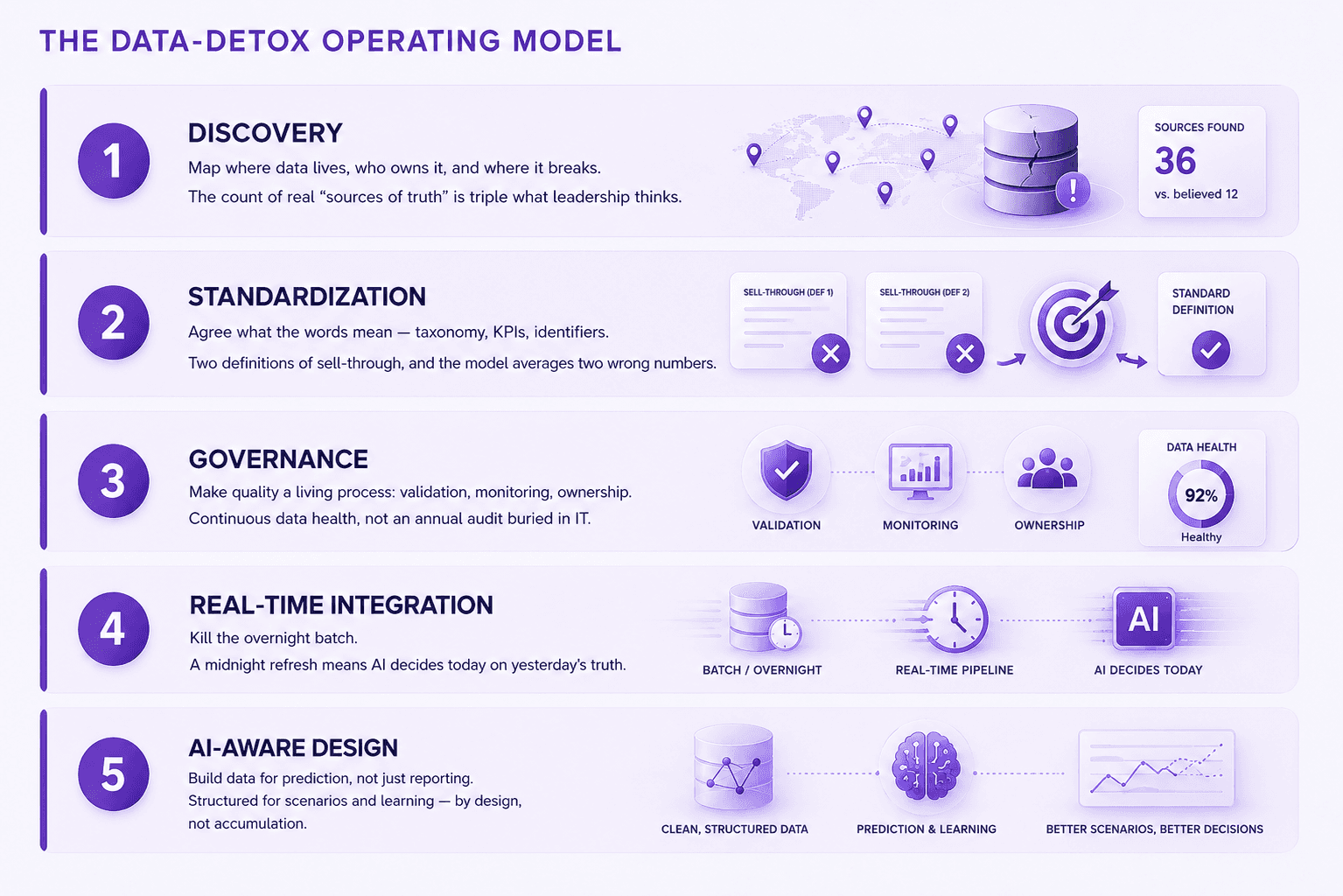
A detox is not a cleanup you hand to IT and review each quarter. It is the operating discipline of making retail data decision-ready: aligned definitions, reconciled inventory, validated inputs, governed ownership, and continuous monitoring before AI is allowed to act. At RETAiLABS, it is built into how Augmented Retail Intelligence (ARI) works, not bolted on after.
Under its Data Harmonization layer, ARI reads POS, inventory, and planning data as it lands, validates it, cleanses what is broken, and harmonizes every source into one trusted version of the truth — the context every downstream decision draws from. It moves planners off the spreadsheet and onto live data, and turns raw market signals into demand the system can act on. Five moves define the work.
The CEO takeaway
Before scaling AI, ask five questions:
1. Do we have one trusted definition of sales, margin, inventory, and sell-through?
2. Can we reconcile system inventory to shelf reality?
3. Do planners know which data they can trust and which data needs review?
4. Are exceptions surfaced before the forecast or replenishment decision runs?
5. Can we measure the business impact of cleaner data in lost sales, markdowns, sell-through, and planner productivity?
AI is only as strong as the data beneath it.
Fix the data before you scale the agent. The goal was never clean data for its own sake. It's decision confidence — trusting the signal before AI acts on it.
The retailers who win the next decade will not own the biggest models. They will own the cleanest data — and the layer that turns it into decisions everyone trusts.
Request a RETAiLABS Data Readiness Assessment — and watch how RETAiLABS turns fragmented retail data into trusted planning decisions.
Drop a line louanndaugherty@retailabs.ai