Every RGM manager who's owned a trade budget knows a specific dread: the forecast that has to land within plus or minus five percent, because your trade dollars are the accruals sitting behind that number. Miss it, and you've committed to spend money you don't actually have for the back half. That single constraint is why so many RGM and finance teams still run their own personal version of the spreadsheet, every cycle — and why a lot of promotional selling still runs on memory of "what worked last time" instead of a live scenario.
It's a strange kind of pressure, because it doesn't announce itself. Nobody gets a warning that this quarter's forecast is off. The number just quietly drifts, the accrual balance quietly tightens, and by the time finance flags it, the team is negotiating next quarter's deals against a funding picture that's already wrong. "You find out you're short the same week you're trying to close a deal," one trade finance manager put it. "That's the worst possible moment to discover it."
The Self-Audit Worth Running
Before anything else, ask your RGM team three questions:
If I asked right now which currently-booked promotions would fail to clear the ROI threshold, how fast could you answer — minutes, or days?
Is a promotion flagged as a winner or a risk before it's booked, or only during the quarterly retro?
On your last three negotiated deals, was the funding balance checked live, or assumed?
If the honest answer to #1 is "days," that gap — between "the deal is booked" and "we know if it clears the floor" — is exactly where margin is leaking. It's entirely possible to run a full year's promotional calendar, discover after the fact that a meaningful share of events missed threshold, and re-book the same losers next year, simply because nothing caught them before the money went out.
If it takes your team more than a few minutes to answer which of these clears ROI threshold, that gap is exactly where your margin is leaking.
The pattern shows up almost identically across companies we've talked to: a retro review, months after the fact, surfaces a cluster of underperforming events, and the retro becomes an autopsy instead of a save. Everyone nods, the lesson gets captured in a slide, and the next planning cycle quietly repeats the same mistake — because the lesson lived in a review deck instead of in the negotiation itself.
Where the Real Leak Is
A consulting engagement gives you an RGM playbook — pricing corridors, ROI thresholds everyone agrees to. Genuinely useful in the room, and a static PDF the moment it's over; nothing in it actually stops a deal from being booked below floor. Six months later, the organization has quietly drifted back to negotiating off memory, because the playbook was never wired into the negotiation itself.
A generic AI dashboard, meanwhile, is very good at telling you trade spend is trending up. After the fact. It's a rearview mirror with better resolution. What it cannot do is gate a live negotiation scenario against the funding balance that actually exists right now, and it definitely cannot simulate three TPR depths against your margin floor in the ten minutes before you walk into a buyer meeting. It reports on the deal. It doesn't help you make the deal.
There's a compliance dimension to this too, one that rarely gets discussed until it becomes a problem. Pricing guardrails — MSRP, EDLP, floor pricing — exist on paper in almost every organization. Whether they hold in practice usually depends on someone catching a violation manually, in a review, weeks after a retailer has already priced below floor. By then, the trade dollars funding that gap are already spent.

What Closes It
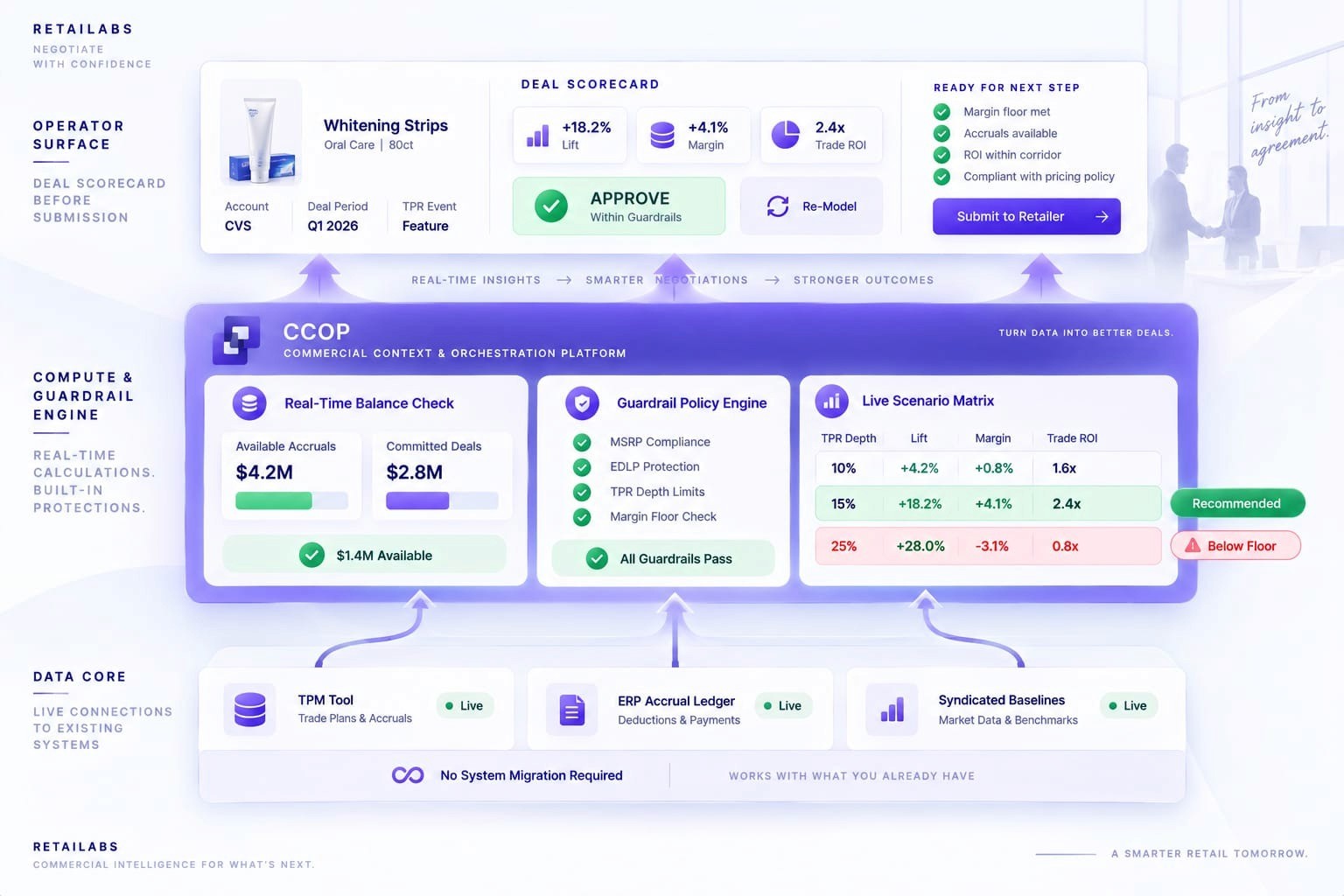
This is the seam CCOP is built to close: trade balance and deal negotiation live in the same view, so a scenario can't get modeled against funding that isn't actually there, and events get an ROI read before they're booked instead of three months after. Guardrail compliance runs continuously in the background, so a below-floor price gets flagged as it happens, not discovered in a quarterly sweep.
Critically, none of this asks a trade team to abandon the TPM they already trust. CCOP sits on top of the technology stack you already have — your existing TPM, your existing accrual system — reading the same funding and accrual data that's already your system of record. It doesn't ask you to migrate trade systems to finally see your trade money in real time. It closes the gap between what your TPM records and what your negotiation team actually knows in the moment.
Know Before You Spend
Ask your RGM lead one question this week: how many currently-booked promotions could your team kill, with confidence, before another trade dollar goes out the door? If the honest answer takes more than a few minutes to produce, that gap — the space between "the deal is booked" and "we actually know if it clears the ROI floor" — is exactly where your margin is leaking.
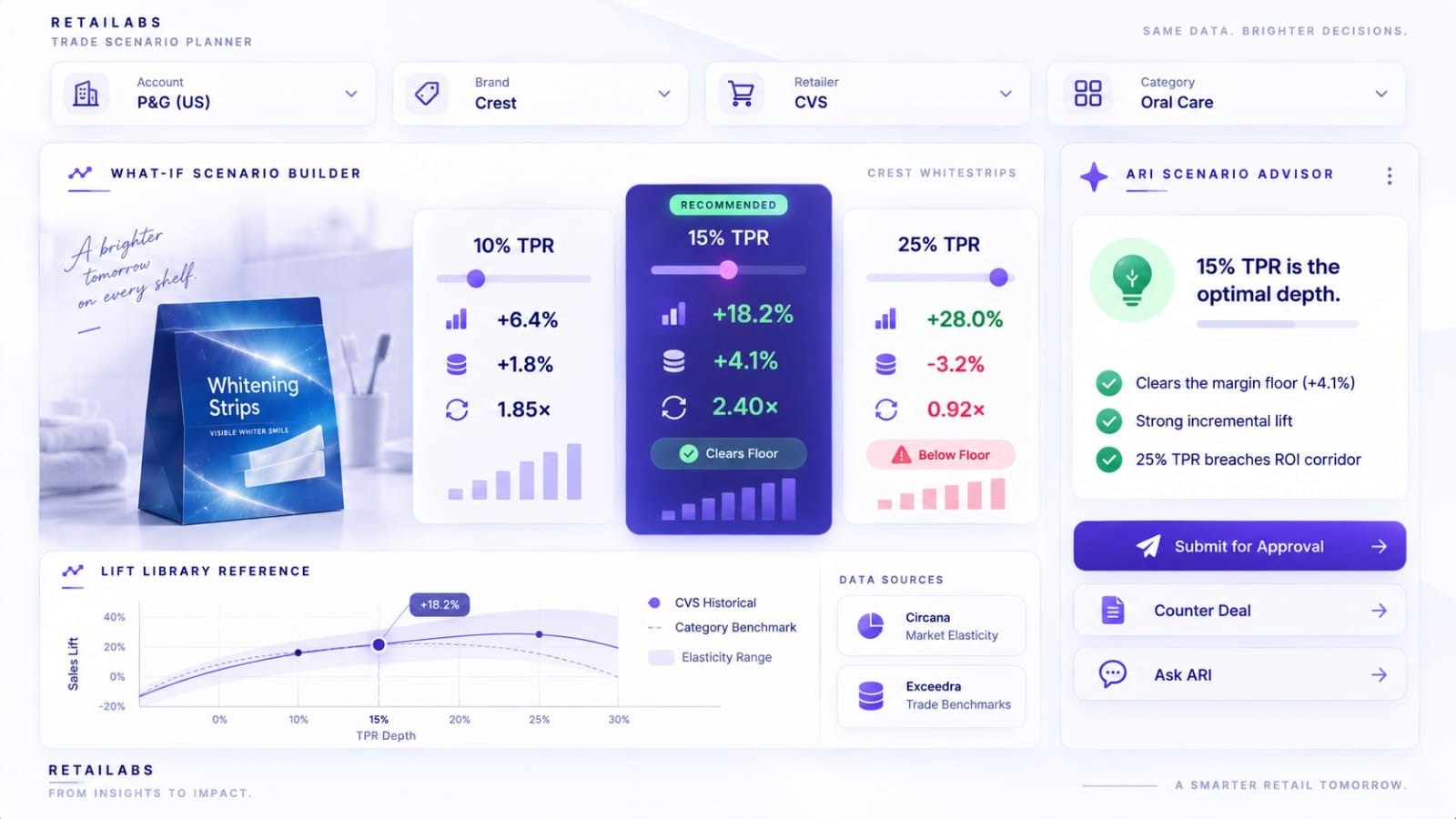
Classifying a deal was never the hard part. Every RGM team already knows how to spot a loser after it's run its course. Knowing before you spend is the part that actually protects the P&L — and it's the part most organizations still can't do in real time.
Not sure your team could clear the ROI question in minutes? Let's look at it together — book time on Calendly or drop a line to lisa@retailabs.ai.