The shelf empties before the spreadsheet does
Walk into any store that's starting to slip and most people will begin to sense it. The shelves aren't quite full, the associate at the register isn't as friendly as usual, the store isn't quite as clean as it has been in the past. Those won’t show up in a report, but the early warning signs are there.
I've spent almost 40 years in retail, more than 30 of them in leadership roles, and I've watched this pattern repeat itself across every kind of disruption. It could be from new competitors, economic pressure, or a category that is past its prime. The businesses that endure and continue to grow and thrive aren't the ones with the best forecasts or systems. They are the companies led by engaged people and leaders willing to recognize situations, read what's actually happening in the stores and tell the truth about it.
That's the real gap. It's not the disruption itself. It's how leaders choose to see it, talk about it, and act on it.

The three lies we tell ourselves when a business starts to slip
Lie #1: The dashboard will catch the issues.
It's tempting to wait for the numbers to confirm what you suspect. You want to support suspicion with data. But conditions deteriorate visually long before they deteriorate on paper. One messy, understaffed, under-stocked store might just be a short-term execution problem. The same pattern across a dozen stores is something else entirely, and you'll see it on a visit to the store before any analyst sees it in a spreadsheet.
Customers give you more room than you'd think. If they've made the trip, they'll dig through a messy shelf and take what they can find for a visit or two. There is plenty of proof for that. However, at some point, they go somewhere they trust to be in-stock, priced right, and can get the help they need. Once that happens, it becomes less about losing a single sale, and more about the regular trips those loyal customers made out of habit.
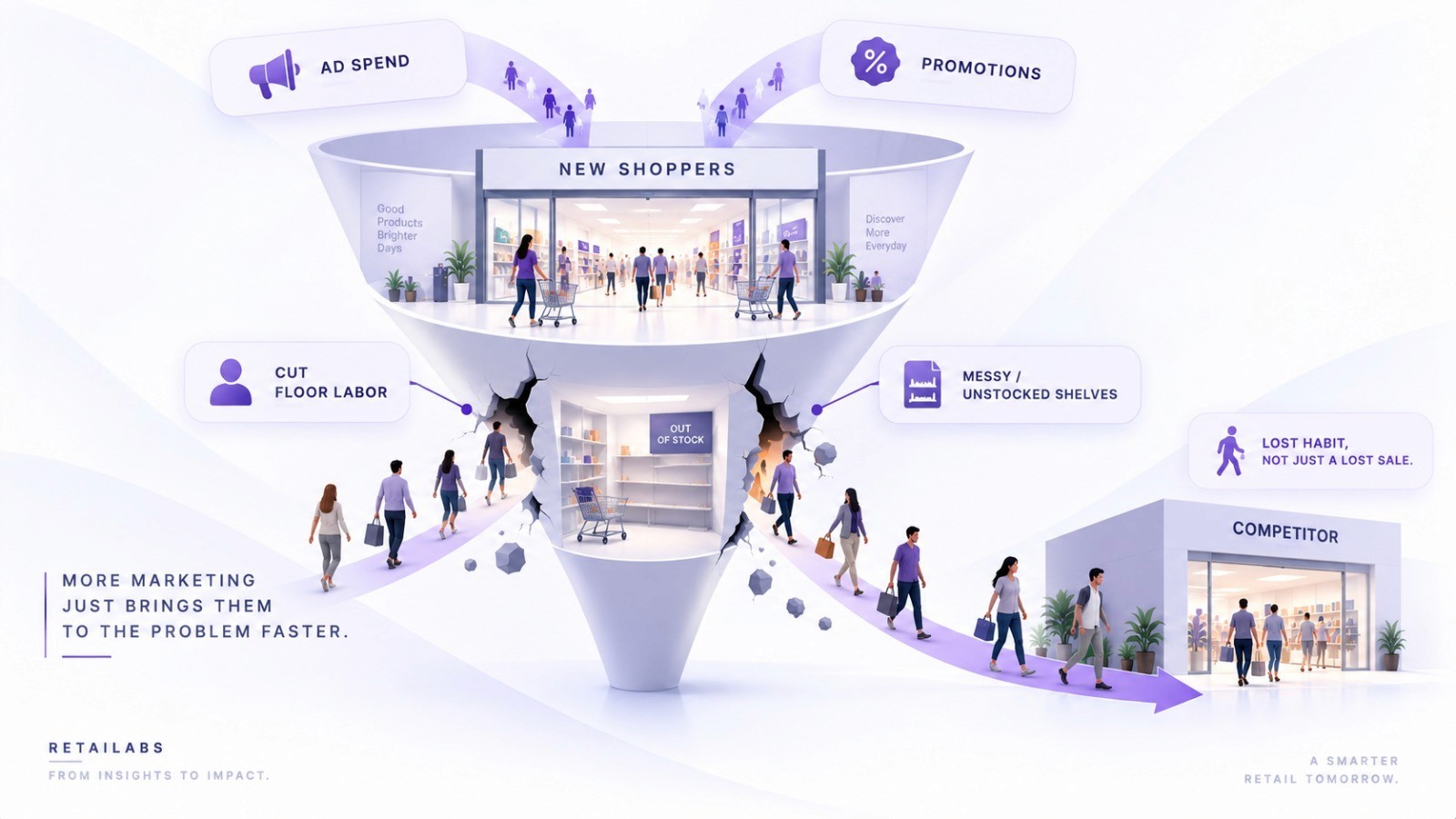
Lie #2: If traffic is down, spend more on marketing to bring people back.
Labor is usually the first thing cut when a business gets tight, because it's the most controllable expense on the P&L. But fewer people on the floor, tighter schedules, longer lines can actually accelerate sales concerns. All the conditions that make a store feel like it's slipping get worse.
At the same time, the instinct is to spend more on marketing to drive traffic back in. Now you have the potential for a bigger problem. You're inviting more people into an experience you've just made worse by cutting the very people who deliver it.
It becomes a cycle that feeds itself - less staff, worse conditions, more marketing spend trying to offset a problem the marketing spend is actually making bigger. The fix isn't "spend more" or "cut more." The first step is being honest with yourself and recognizing what actually creates a better experience, and where it's just throwing good money after a bad customer experience.
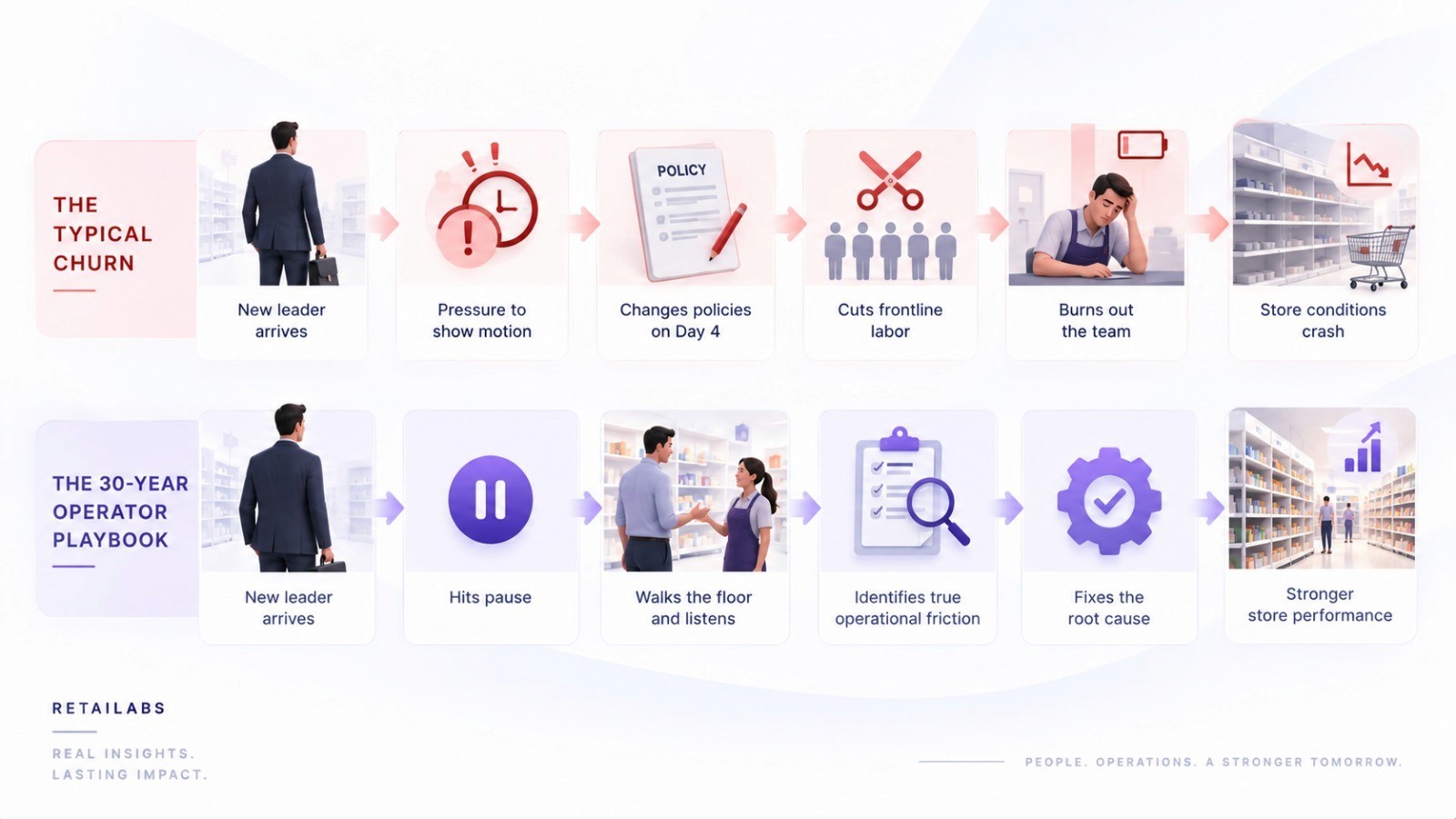
Lie #3: Moving fast on day one proves I'm the right leader for this.
Every leader walking into a turnaround feels the pressure to show movement immediately. There's an expectation set before you even start: you're here to shake things up.
So the instinct is to observe for a few days and then start changing things by day four, before you actually understand why the business is struggling in the first place. It burns people out, either because you're taking them in the wrong direction or because they don't understand why you're moving so fast. I have experienced this first hand from every perspective.
The biggest miss in most turnarounds isn't the plan. It's skipping the pause at the beginning and taking the time to actually understand what you've walked into before you start changing it.
Leading Through Disruption the Right Way
Three things I'd tell any leader walking into a business that's starting to struggle:
First — protect what people feel, not just what's easiest to cut. Labor and people-driven programs are usually the first line item to go. Before you cut them further or to fund more marketing, ask honestly where that next dollar actually builds a better experience.
Second — be honest, even when honesty means saying "I don't know." People can tell the difference between a leader who's spinning and one who's telling the truth about a hard situation. Say what you know, and say what you don't, and if there's something you can't share yet, say that too. Most people understand once you explain it.
Third — pause and observe before you act. Take the time to understand the full "why" behind the decline before you start making changes. You have more time than the pressure to "do something" makes it feel like, and the businesses that skip this step almost always end up making the recovery take longer, not shorter.
The RETAiLABS Approach
Here's the part most companies get backwards: they invest in the technology first and the people second, then wonder why adoption stalls. Cloud platforms, forecasting tools, data lakes — CPG and retail have poured over $300 billion into this kind of tech, and the decision-to-execution chain is still broken. Roughly three out of four AI pilots never make it to production, and the ones that do usually stay stuck in planning — new dashboards, same manual work, insights that never connect to what actually happens on the floor.

That's the same gap Chris is describing from the store side. The warning signs show up in real conditions — on shelves, in staffing, in how a team feels — long before they show up in a report. Most systems are built to report on that after the fact, not catch it while it's happening.
RETAiLABS' ARI orchestration engine is built to close that gap instead of widening it. It pulls in external and internal signals, harmonizes the data behind them, and turns that into cross-functional workflows and agentic actions — a closed loop from signal to decision to execution, not another dashboard sitting between the people who see the problem and the people who can fix it.
It also solves the problem Chris raises about experience walking out the door. When an account executive or a store leader who's carried years of context changes roles, that institutional memory usually leaves with them. RETAiLABS' governance layer is built to hold onto it — so the pattern recognition a 30-year operator carries in their head becomes something the whole organization can actually use.
What Comes Next
Every leader eventually faces some version of this choice: keep waiting for the quarterly report to confirm what the floor already knows, or build the habit of reading the real signals and acting on them honestly, before the spreadsheet forces your hand.
The businesses that come through disruption well aren't the ones that avoided it. They're the ones that told the truth about it early, protected the right things, and gave their teams a reason to stay through the hard part.
If you want another take on how your team reads the early signs of disruption, reach out — chris@retailabs.ai