Five minutes on the floor beats a thousand hours of data.
A store manager can walk into their store, stand back for five minutes, and tell you things no dashboard will ever show you.
They see how customers are flowing through the aisles. They see which sections capture interest and which customers walk past. They see which products are flying off shelves and which are just sitting. They see the energy of their team. They see what's breaking down in real time.
They also know every problem in that store. The leaky roof they've been reporting for eight months. The register that reboots every third transaction. The supplier delivery that's been late every week for two months. The new cashier who's slower than normal.
They know the problems that never make it to any report. And they know what's actually possible given the constraints they're dealing with.
Yet almost nobody asks them.
And when you do ask, most of the time you get silence. "No, everything's fine." Spoiler: It is not because it's actually fine, instead, they've learned that telling corporate leaders about problems means they may get labeled as a complainer, not someone focused on the negatives. Real or perceived, this is an issue many companies face.
After 30 years in retail, I can tell you: That's the biggest resource we're leaving on the table.
Why the insight never travels up
I've worked in stores. I've managed stores. I've led field teams. And I can tell you exactly why store managers don't voice what they know:
Reason #1: Nobody asks the right question.
If a regional manager comes into your store and says, "How's everything going? Anything we can fix?" you're probably going to answer: "Fine. Everything's good."
Why? Because you've got work to do. You know there are seventeen things that need fixing. But the question feels surface-level, and you're not sure if the person asking actually wants to hear about problems or just wants you to say everything's fine so they can move to the next store.
But if someone comes in and says, "I noticed your spacing in seasonal is larger than many similar stores. Do we get you enough of the product you need? Does it take longer to set than other stores? Does this much space make sense for your store? Suddenly there is engagement.
Why? Because they came with knowledge. They noticed something specific. They're asking about a real thing, not a vague "how's everything." The questions are open ended and lead with curiosity.
Now there is a real conversation because someone treated your observations as valuable.
Reason #2: There's no safety.
Store managers know that sometimes, when you report a problem, the person who reported it gets blamed for the problem. Not fixed, blamed.
"Your shrink numbers are high." "Why?" "Because I don't have enough labor to properly support the floor." "Well, everyone would like more payroll, imagine how much that costs if we give everyone more payroll.” Generic question, generic answer, unhelpful response.
So next time a store manager notices opportunities, they don't report it. They just manage it quietly. And the company doesn't know there's a problem until it affects P&L.
Store managers will tell you everything if they trust that (a) you actually want to hear it, and (b) you'll do something with it. And, even if there isn’t a great answer to provide, acknowledging the situation, listening to the thought process, and having a discussion goes a long way in finding solutions that may not be exactly what was hoped for, but everyone learns something and feels better for it.
Reason #3: They're too busy.
If a store manager is running a skeleton crew, getting calls from customers complaining about out-of-stocks, and dealing with staff scheduling on the fly, they're not thinking about systemic problems.
They're surviving. They don't have the mental space to think about "I notice this pattern" because they're focused on "Can I get through today?"
What you're missing when you don't listen
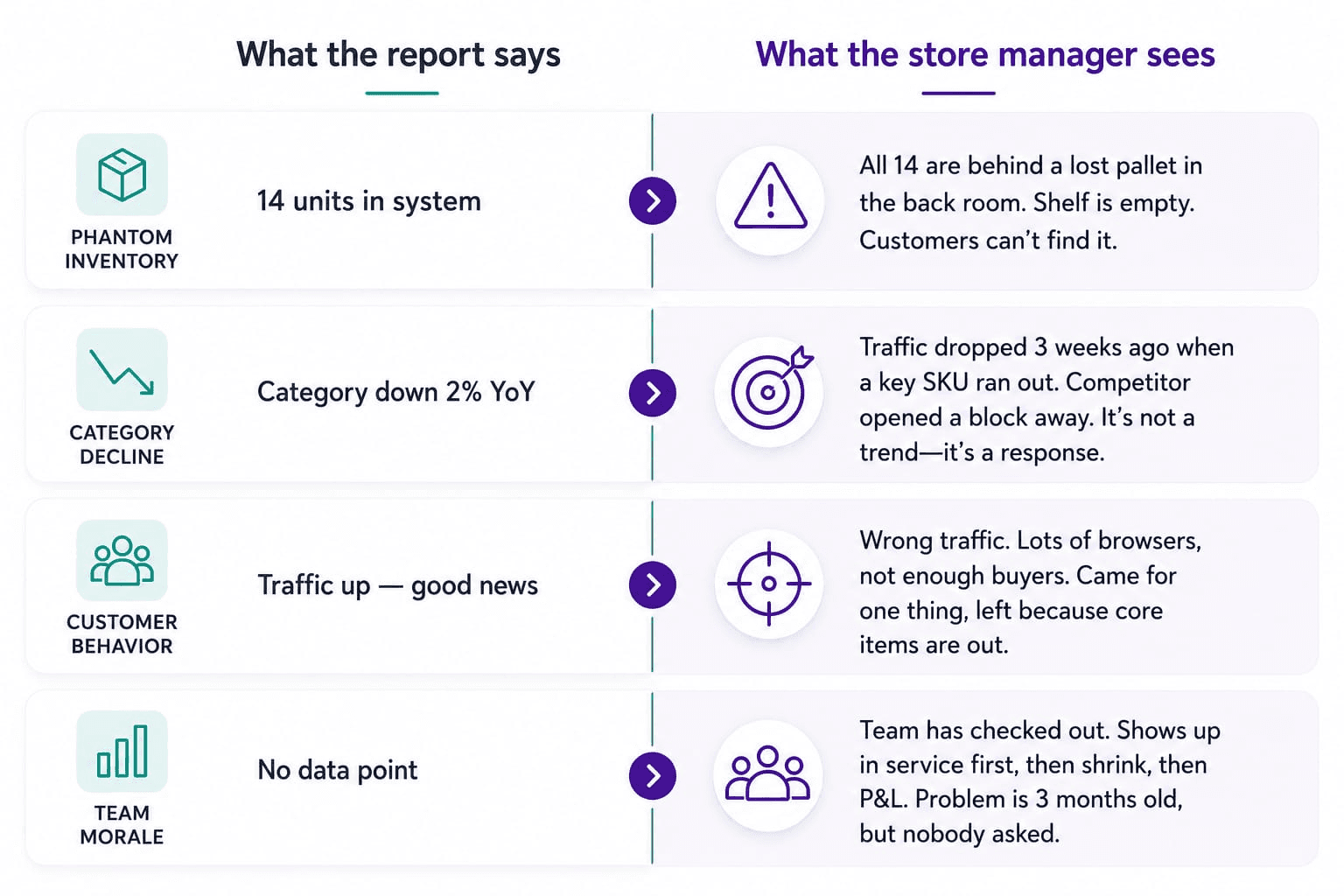
Here's what store managers see that the reports don't:
Phantom inventory: A report says 14 units in the system. A store manager can likely tell you quickly that 14 units are in the back room behind a pallet, and the shelf is actually empty.
Category decline: An analyst sees a 2% drop in a category year-over-year. A store manager can tell you that three weeks ago, all of the items from that vendor went out of stock. Or because a competitor opened a block away. Or because they never recovered the endcap properly after the planogram reset.
Customer behavior: A report shows traffic is up. A store manager sees that traffic is up, but they are not converting. A lot of browsers, not buyers. Or it's customers coming in for one thing and leaving because the rest of the store is a mess.
Team morale: Nobody reports this. But a store manager knows when their team is disengaged. And that shows up in customer service, shrink, and eventually, in numbers.
What actually works: A store manager knows which promotions actually drive traffic, which displays customers actually stop at, which seasonal resets take off versus which ones die.
All of that lives in a store manager's head. And almost none of it makes it to corporate.
How to actually listen
If you want to hear what store managers know, you have to create an environment where it's safe and valuable to tell you.
Come with specific knowledge.
Don't ask a vague question. Come with context. "I see your labor hours are 2% below plan. How are you managing? Do you need something from us?"
That signals you've been paying attention. That you care. That this isn't just a drive-by.
Ask them to solve it, not just report it.
Don't ask, "Why is this happening?" Ask, "If you were running this from corporate, what would you do differently?"
Store managers are problem-solvers. Give them a real problem to solve and they'll engage.
Listen to what they say without immediately negotiating.
A store manager tells you, "I need more labor to hit the recovery targets." Don't immediately say, "That's not in the budget." Say, "Tell me more. What would it look like?"
Then you have a real conversation.
Create a culture where reporting problems is valued, not penalized.
If a store manager tells you something is broken and the first thing that happens is they get blamed for it, nobody will tell you anything ever again.
But if they tell you something is broken and the response is, "Thank you for surfacing this. Here's what we're going to do," suddenly they're a valued partner, not a problem reporter.

The RETAiLABS Solutions
The problem I see over and over is this: Store managers have all this knowledge, but the system doesn't have a way to systematically surface it and act on it.
RETAiLABS is built to close that gap. ARI is designed from the ground up to make store manager insight actionable at scale.
Instead of asking store managers to report problems and hoping the information bubbles up, ARI surfaces real-time signals about what's actually happening in each store—inventory gaps, customer behaviors, emerging issues—and puts that context directly into the hands of the people who can do something about it.
It creates a feedback loop. Store managers see that their observations and insights are being heard, surfaced, and acted on. That changes everything.
Suddenly, the store manager who knows their business isn't shouting into the void. They're part of a system that actually listens and responds.
What great retailers actually do
The retailers who run best-in-class operations have figured this out: Store managers are not order-takers. They're the most valuable source of intelligence you have.
They hire well. They support their store teams in developing those insights. They create systems where local knowledge is valued and surfaced. They trust store managers to help guide strategy, not just execute it.
At Costco and Walmart, you hear the same thing over and over from people at every level: "They listened to me. They valued what I knew. They helped me grow."
That's not culture. That's infrastructure. It's systems and practices and leadership behaviors that say: "What you know about your store matters. And we're organized to hear it and act on it."
What you should ask yourself

Here are three questions for any leader in a multi-unit retail or CPG organization:
Could I walk into any store and have a 20-minute conversation with the manager that reveals something I didn't know? If the answer is no, you don't have enough of a listening infrastructure.
How many times in the last month has a store-level insight changed a decision made at corporate? If the answer is zero, your stores aren't actually part of your decision-making.
Do my store managers feel like they can tell me about a problem without getting blamed for it? If not, they're not telling you about problems. They're just managing around them.
Fix those three things, and you've just unlocked an entire intelligence system you already own.
Request a RETAiLABS Store Assessment — and watch how RETAiLABS turns fragmented retail data into trusted planning decisions.
Drop a line - chris@retailabs.ai


Chris Richardson
Chris Richardson has spent 30+ years in retail store operations, leading teams across hundreds of stores. He's seen how store managers—the people closest to customers and the market—are either the most powerful resource a company has or the most muted voice in the room, depending on whether you actually listen.
SELECTED SOURCES :
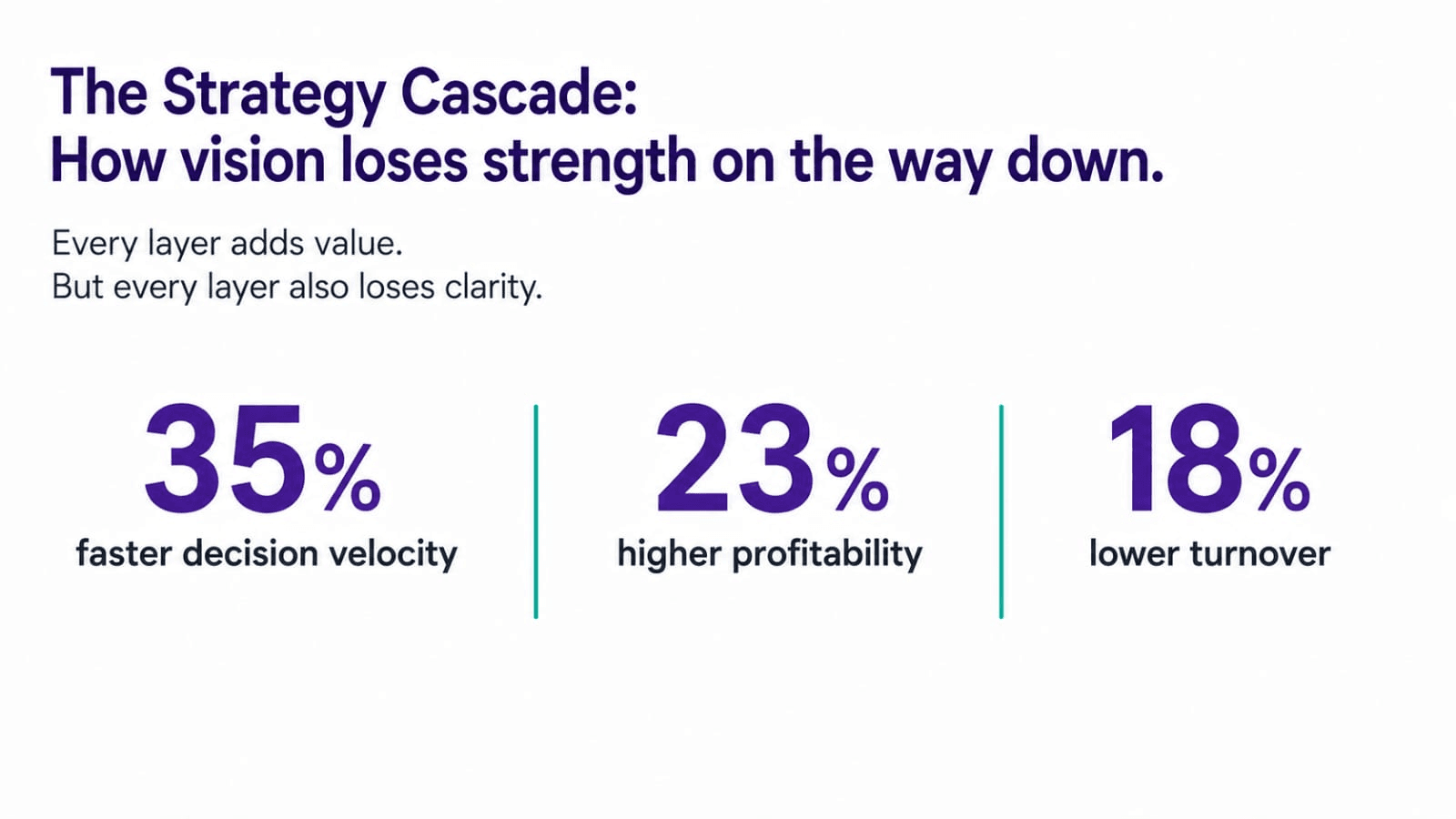
Harvard Business Review — The Power of Frontline Insights (2024): Organizations that actively collect and act on store-level feedback see 35% faster decision velocity and higher execution quality.
Retail Insight — Store Manager Engagement and Business Performance (2023): Engaged store managers (those who feel heard and valued) lead stores with 23% higher profitability and 18% lower turnover.
MIT Sloan — How Leading Retailers Build Insight-Driven Cultures (2025): Best-performing retailers systematically surface store-level observations and integrate them into strategic decisions.