Every Retailer Already Forecasts
Every retailer already has a forecasting process.
Whether it runs in Excel, Python, SAP, Blue Yonder, or an in-house planning system, the fundamentals are largely the same. Forecasts are built from historical sales, inventory positions, promotions, seasonality, and years of operational experience. Modern retail has become exceptionally good at understanding what has happened inside the business.
Forecasting isn't the problem.
The challenge is that stores don't operate inside the business.
They operate inside neighbourhoods.
The Store Doesn't Live Inside Its Four Walls
While planners are looking at historical demand, the world around every store continues to change.
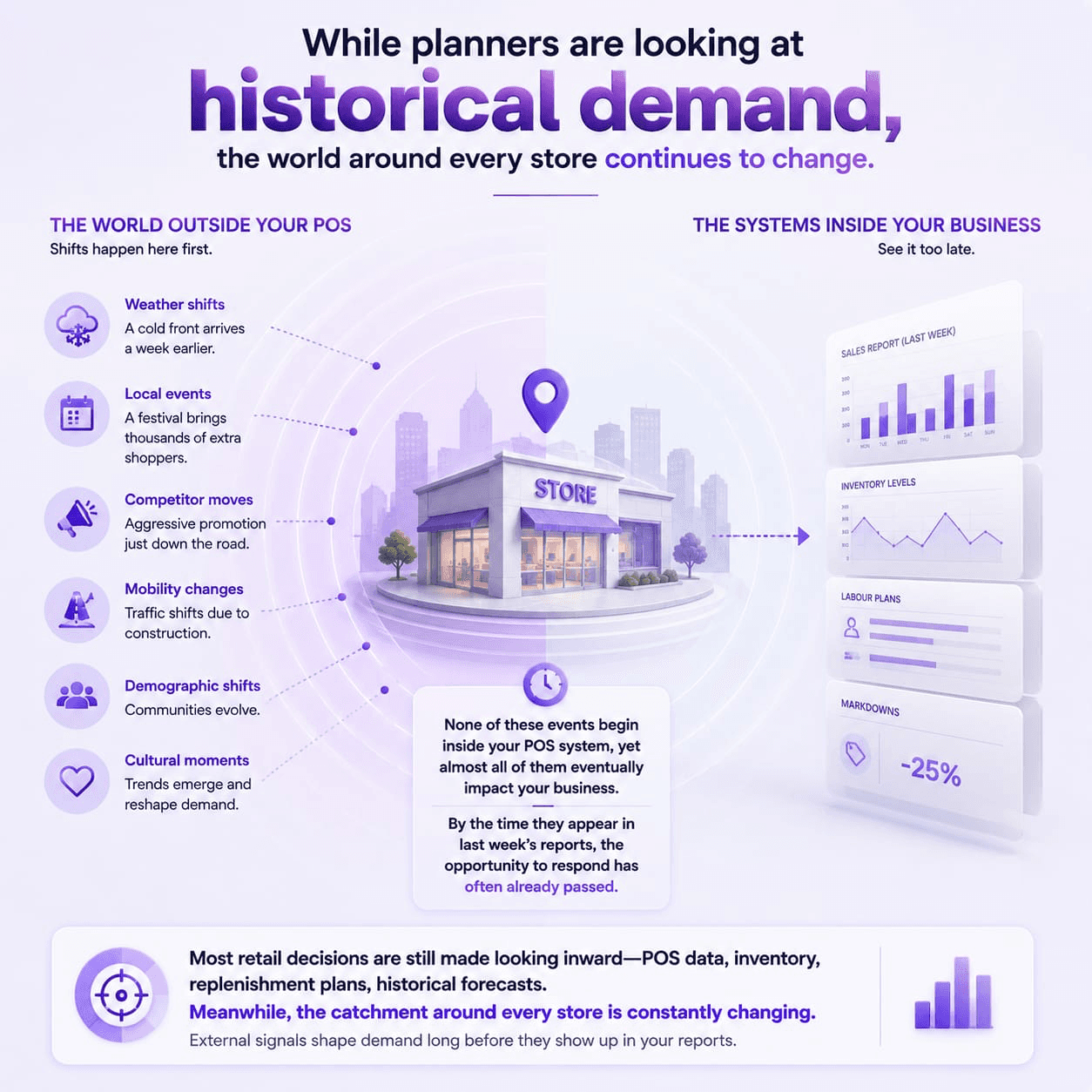
A cold front arrives a week earlier than expected.
A local festival brings thousands of additional shoppers into the area.
A competitor launches an aggressive promotion just down the road.
Traffic patterns shift because of construction.
Demographics evolve.
Cultural moments reshape demand.
None of these events begin inside your POS system, yet almost ap0ll of them eventually find their way into your sales, inventory levels, labour plans, or markdowns.
By the time they appear in last week's reports, the opportunity to respond has often already passed.
Most retail decisions are still made looking inward—POS data, inventory, replenishment plans, historical forecasts. Meanwhile, the catchment around every store is constantly changing. Weather, local events, competitor activity, demographic shifts and mobility continue to influence demand long before they appear in internal reports.
The Missing Layer Between Signals and Decisions
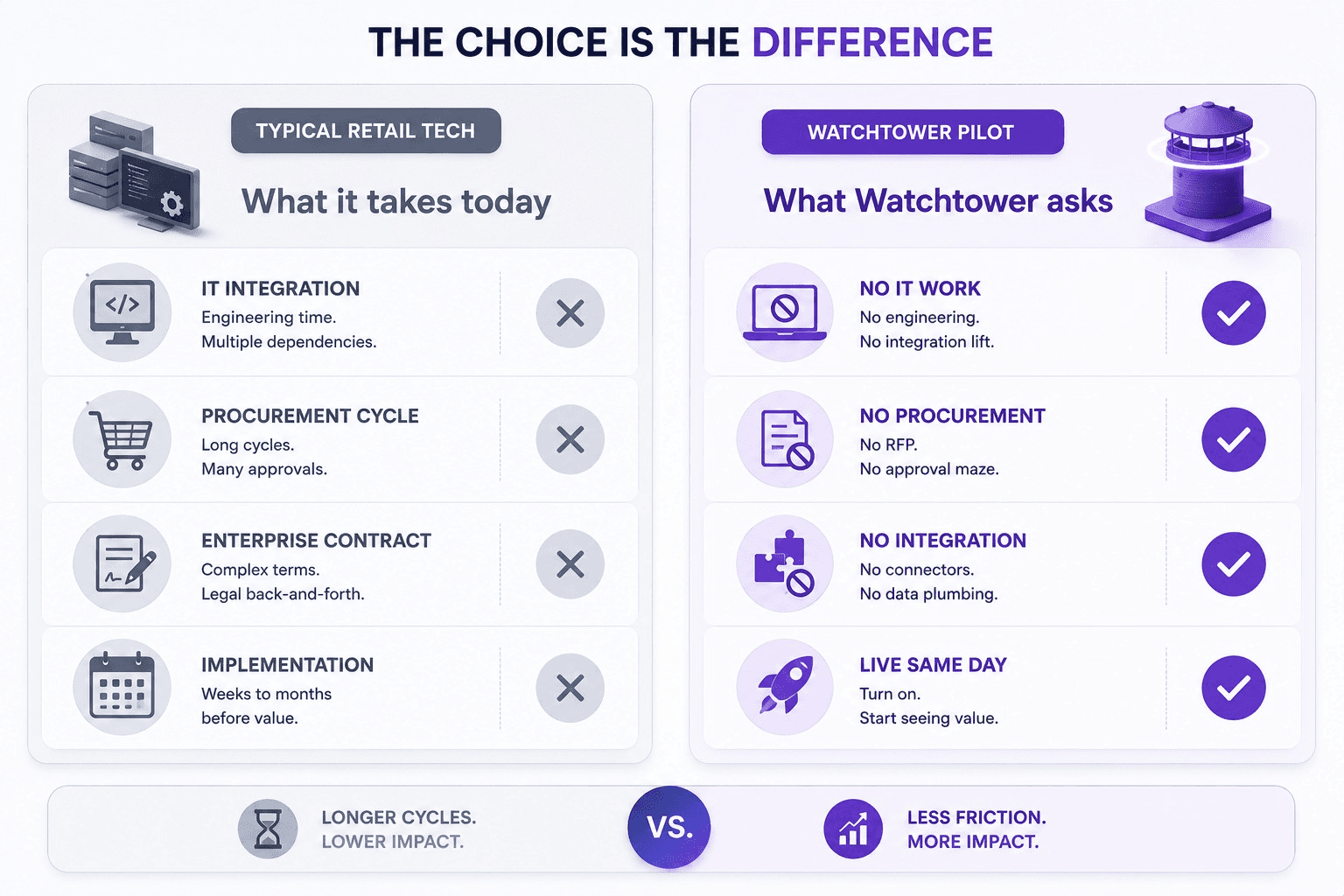
That's the gap Watchtower was built to fill.
Not by replacing the forecasting systems retailers already trust, but by adding the context they've always been missing.

Watchtower continuously monitors the changing environment around every store—its catchment—and surfaces the external signals most likely to influence retail performance. Weather. Local events. Competitor activity. Demographic shifts. Traffic. Cultural moments. Instead of waiting for those changes to show up in sales reports weeks later, retailers gain visibility while there's still time to act.
It's an outside-in intelligence layer that complements existing planning systems. Historical data explains where you've been. Outside signals help explain what's about to happen.
Why the P&L Is the Only Language That Matters
Of course, none of this matters if it doesn't translate into business outcomes.
Nobody gets budget approved by saying "AI-powered insights." Store operations leaders respond to the language they already manage: shrink, markdown rate, labour hours, comp sales, stockouts. If a tool can't improve one of those lines, it doesn't matter how sophisticated the technology sounds—it won't get funded.
The real question isn't whether outside signals matter.
It's what they're worth.
Three Signals. Three P&L Outcomes.
Across grocery, apparel, and specialty retail, the pattern is remarkably consistent.
An external signal becomes an internal decision.
Catch it early, and it protects margin.
Miss it, and the cost eventually shows up somewhere in the P&L.
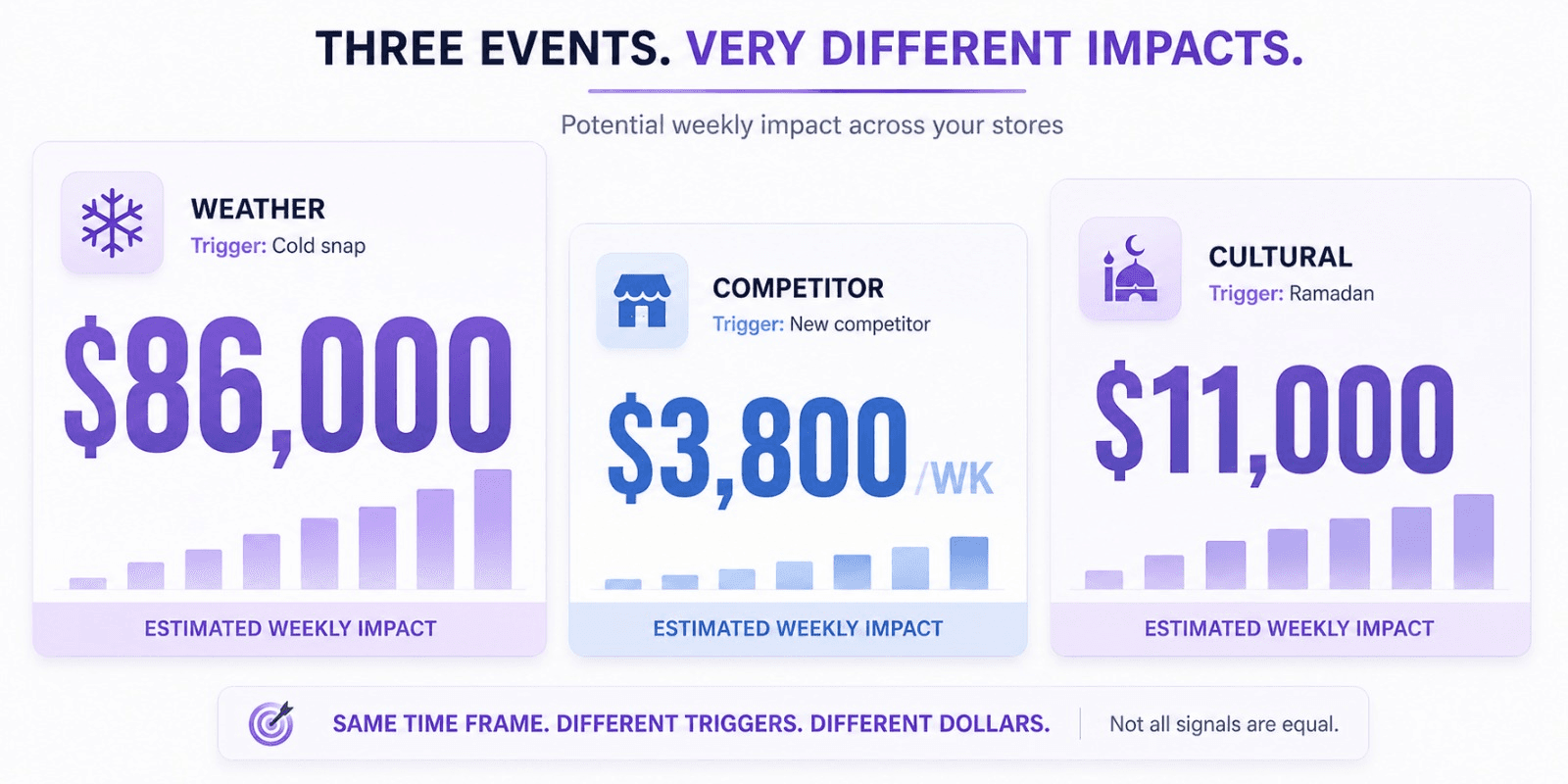
Weather → Apparel. A cold snap lands ten days early across fourteen Midwest stores. Move coats into those stores, hold the outerwear markdown, swap the promotion, and staff the weekend rush—and the event is worth $86,000. Miss it, and that value quietly becomes markdown loss and stockouts instead.
Competitor → Specialty. A competitor opens 1.4 miles from one of your stores with a six-week, 30%-off offer. Defend your key value items, launch a local counter-offer, and reposition the shelf. Worth $3,800 per week for the duration of the promotion. Ignore it, and that traffic simply walks to the new store.
Cultural → Grocery. Ramadan arrives in six days, affecting the catchment around nine stores. Get the assortment right, secure supply for staple products, and protect pricing—and it's worth $11,000. Miss the window, and you're left with stockouts during demand or markdowns after the fact.
Facing a similar issue? Let us review it together. Drop an email at lisa@retailabs.ai