The strategy was brilliant. The stores never saw it.
A major retailer rolls out a "store-centric merchandising" initiative. The vision is right there in the deck: let store managers customize assortment based on local demand. More autonomy. Better sell-through. Faster turns. The planning behind it is solid. Weeks of cross-functional work. Category, planning, operations, IT, all signed off. The deck looks great.
Then it hits stores as a 47-page manual, five new reports, three different data sources, and one line: "You now own local assortment decisions." No guidance on how to actually make those decisions. No word on what support is coming.
Six weeks later, half the stores aren't using it. Store managers are frustrated. District and regional managers are quietly covering for the chaos. The vendor who built the system can't figure out why adoption is so low. The postmortem blames execution. "Store managers just won't adopt new things." I've heard some version of that sentence at every level of retail for 30 years, and it's almost never true.
The strategy didn't fail because stores wouldn't execute. It failed because it got translated, diluted, and misunderstood somewhere between the slide deck and the sales floor. That happens more often than businesses realize.
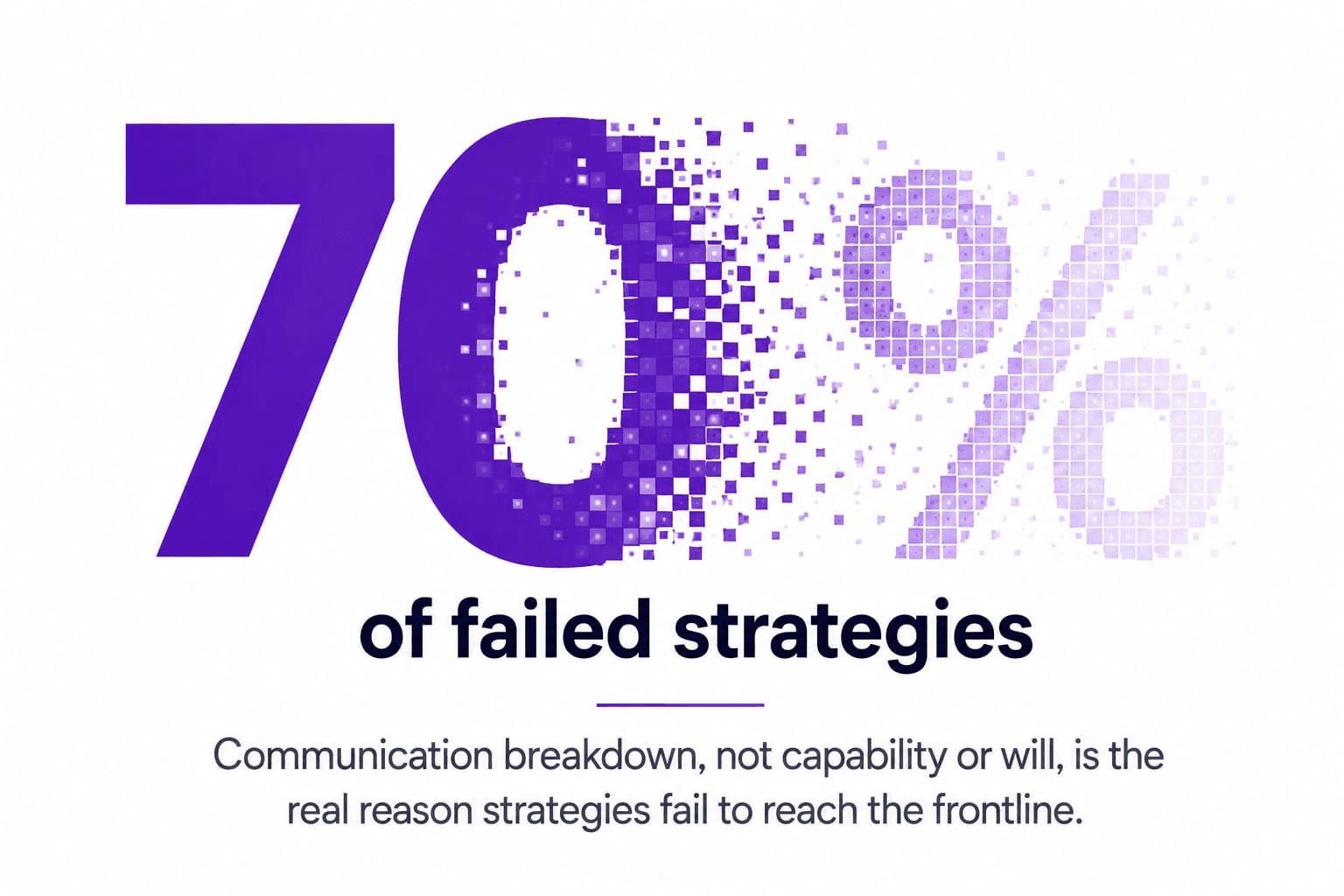
Here's how often: Research from Boston Consulting Group found that 70% of failed strategy implementations traced back not to capability or will, but to communication breakdown. The vision made sense at the top. By the time it reached the frontline, it had been translated so many times that nobody could explain why it mattered.
Where strategy loses energy
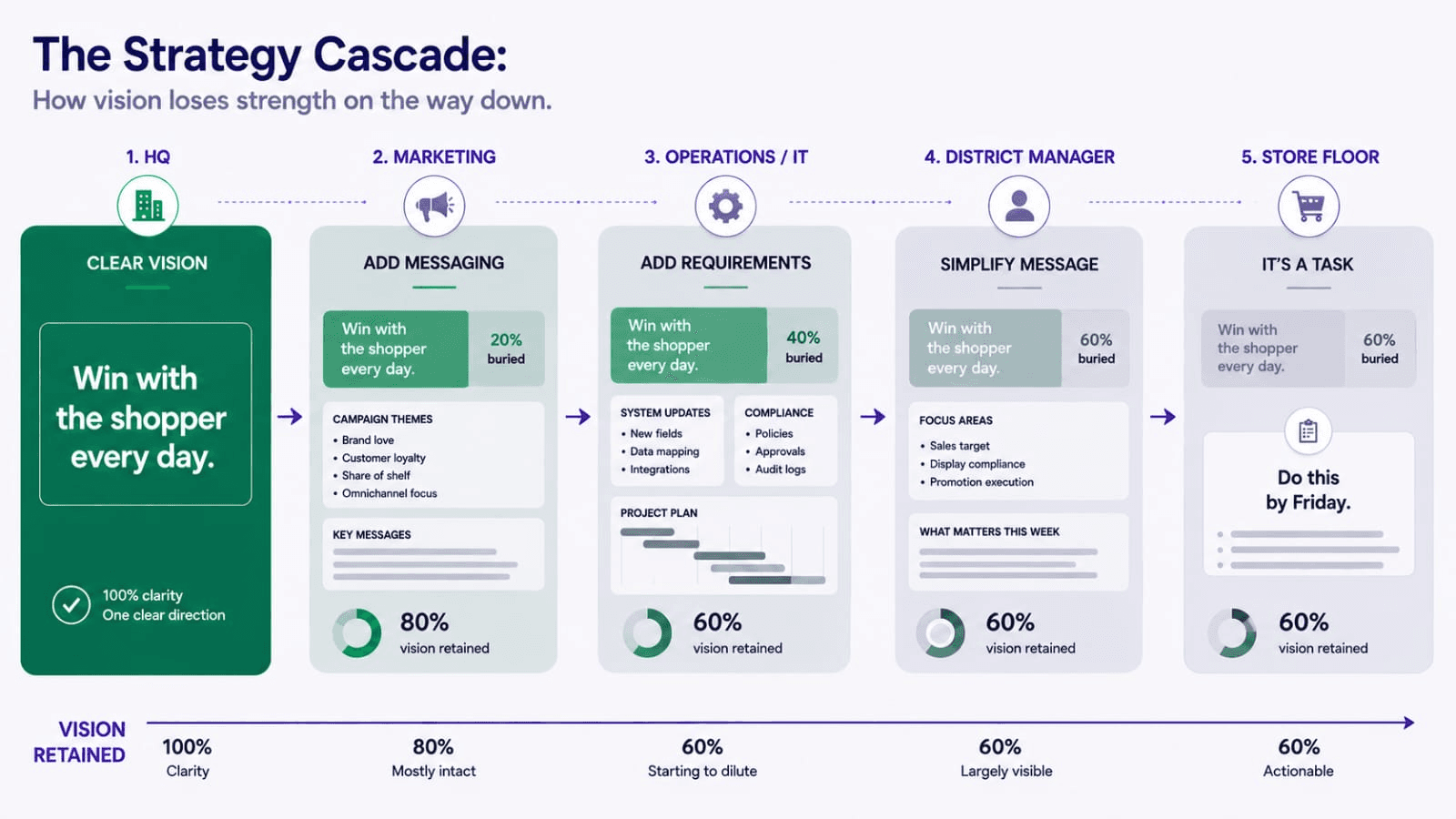
When you build an initiative at corporate, you own the context. You know why you're doing this, what problem it solves, what tradeoffs you weighed to get there. That context gets stripped away at every layer it passes through. Marketing adds messaging. Operations adds requirements. IT adds guardrails. Procurement adds cost constraints. Somewhere in there, the original idea, ‘give store managers room to move faster’, gets buried.
By the time it reaches a store manager, it's not a vision anymore. It's a task. Log in here. Do this by Friday. Then a district manager trying to protect their teams looks at it and thinks, "This is one more thing. My stores are already underwater. Let me simplify this." So they strip down the message. But simplifying removes the why along with it. Store managers don't know what problem this solves. They just know it's new, and it's theirs to do.
I started on a sales floor before I ever sat in a corporate office, and I still joke about it: I used to think the people in the office were stupid. They clearly had no idea what they were doing. That's why I wanted to go fix it. Now I'm one of them.
The point isn't that the office is clueless. It's that the view from a store and the view from corporate are two different realities, and if nobody works to connect them, the vision dies somewhere in between. Every layer in that chain can add energy or drain it, depending on whether the why is clear. A regional manager who believes in a strategy can hand that conviction down. One handed a vague mandate protects their stores by saying as little as possible. Don’t confuse that with laziness or lack of compliance. That's a leader doing the only thing they know how to do with incomplete information.
Why the postmortem misses the point
When initiatives fail, the postmortem reads the same way every time. Stores didn't execute. Adoption was weak. Execution broke down.
Nobody asks why execution broke down.
Was the store manager missing the vision? Were they buried under ten other priorities? Are they missing the tools to do the thing? What is the priority that we are pushing for, and is that clear how that benefits everyone? Those questions help discover the real answers, and they rarely get captured to define where the breakdown was. That dooms future initiatives as well.
I ran stores where a new initiative was communicated and I had no idea what the corporate vision actually was beyond "do this." No idea if it mattered more than what my district manager told me to focus on the week before, or if I was supposed to pull someone off the register to make it happen, or if help was coming. So I did what I always did. I prioritized based on what my customers needed and what my team could actually handle that day. The new initiative landed somewhere down the list, behind the things I understood.
Store leaders are going to make the decisions that impact them and their customers and teams first. If there is not a clear understanding of the importance, it won’t get done.
The fix isn't "communicate more." It's communicate right.
Every message from corporate gets read as a directive, which makes executives gun-shy about saying too much. So the instinct becomes: keep it simple, say less. Wrong instinct. The answer is being abundantly clear about the why, and about what you're actually asking people to do.
Here's what I'd tell any C-suite leader before the next rollout.
First, ask the people who actually have to run it. Not a survey. Sit down with real store managers, not the district or regional managers speaking for them, and ask: here's what we're trying to do, here's what we need from you, does this work? A store manager dealing with realities every day can tell you in five minutes whether your plan holds up, or what you're missing. At a minimum, you’re going to learn where the communication gaps are as they hear the initiative.
Second, make sure every layer between you and the floor understands the vision well enough to explain it in their own words, but still captures the real meaning of the expected outcome. Don't cascade a memo. Get in front of your field leaders and tell them why this matters, then ask them to carry that same conviction down to their teams. A regional manager who can't explain the why with any energy isn't going to pass it down with any energy either.
Third, be honest about timing, resources, and what's already competing for attention. If stores are mid-planogram-reset and short-staffed when this lands, say so. Tell them what's hitting them at once and how you're going to help. Don't say "this matters" and circle back in six months asking why nobody did it.
Don’t make a planning problem and communications problem.
Where RETAiLABS fits

This is the gap RETAiLABS is built to close. Most companies try to fix this by writing a better memo. RETAiLABS works on the other end of the problem, keeping the context alive after the memo goes out.
Instead of a directive that gets thinner every time it changes hands, a store manager sees their own store's data tied directly to the priority. What's happening in their store right now. What the recommendation is and why it matters for them, specifically.
The vision doesn't get diluted because it's never reduced to a memo in the first place. It's something the store manager sees reflected in their own numbers, every day.
That's the difference between a strategy that sounds good in a deck and one that survives contact with the floor.
What actually separates great retailers
Put two stores on the same initiative with the same resources, and one runs with it while the other stalls. The difference is almost never the store. It's the leadership in that store.
A manager who understands why, who feels backed by their leadership, who's gotten a clear answer to "what matters most this week," runs differently than one who hasn't.
You can't manufacture that manager. What you can do is make sure the vision survives the trip down. Keep the context intact. Make sure the resources show up when you said they would. Make sure every leader in between believes in it enough to pass that belief on.
Do that consistently, and you'll be surprised how much faster things start moving.